
Before we begin
This essay builds on ideas introduced in Part 2: Deep vs. Shallow Processing.
If you haven’t read it yet, you can find it here: Deep vs. Shallow Processing
We often assume misunderstandings come from personality, education, tone, or emotional sensitivity.
But the real divergence begins far earlier — at the moment input enters two different internal systems.
People process reality at different depths, and those depths shape how meaning forms long before language appears.
This essay breaks down what actually happens inside a deep processor and a shallow processor when they encounter the same moment — and why their interpretations drift apart even when both are well-intentioned.
1. The Input Looks the Same — but Enters Different Systems
Two people receive the same signal:
a sentence
a facial expression
a shift in tone
a situation that needs a response
But the signal does not land the same way.
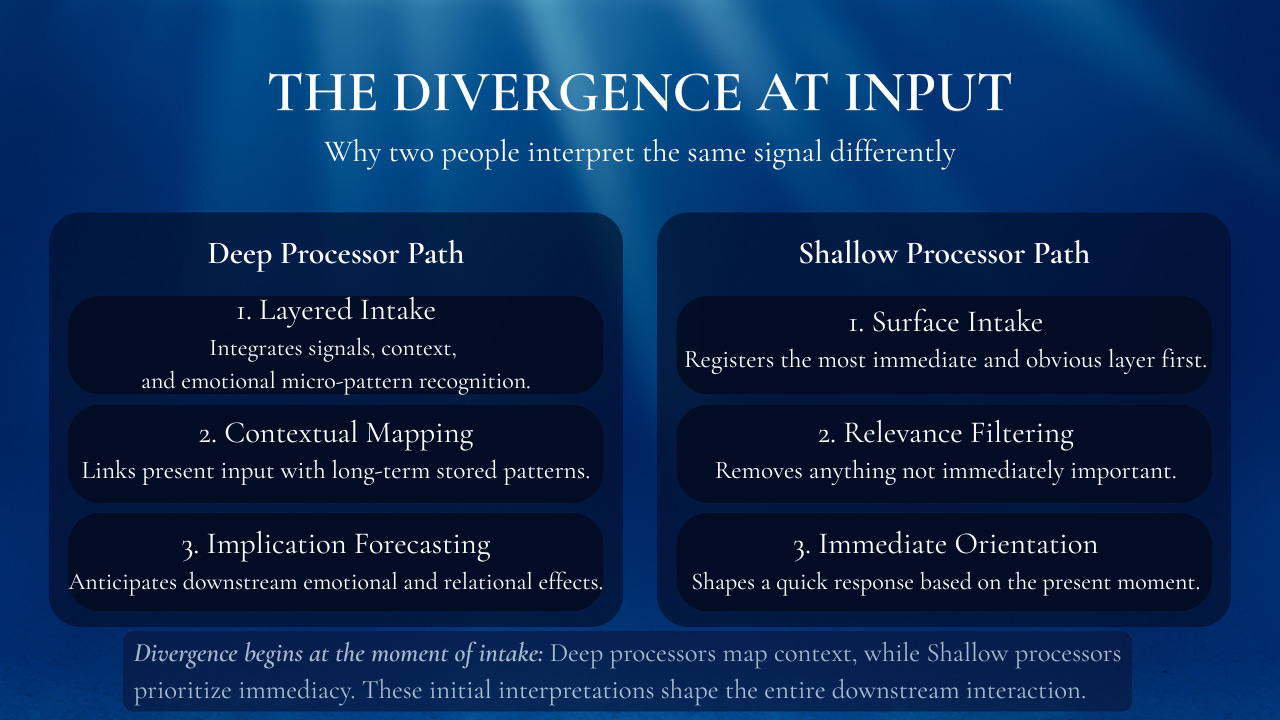
Deep processors begin integrating layers.
Shallow processors begin identifying the actionable surface.
Not because one is better or worse —
but because their systems are built to sort reality differently.
2. The Three Axes That Shape Depth
Misunderstanding isn’t random.
It arises from the interaction of three internal dimensions:
1) Cognitive Processing Depth
How many layers we integrate before meaning forms.
2) Interaction Depth
How deeply we read a moment — emotional, contextual, relational.
3) Emotional Energy Density
How much internal load each moment creates.
Depth is not a personality trait.
It is an internal architecture.
A deep processor in high-density mode will read a moment differently from a shallow processor in low-density mode — even if both are equally intelligent, kind, or experienced.
3. How Deep and Shallow Minds Diverge (Long Before Words)
The diagram below shows how two processing paths diverge the moment input enters the system.
1. Difference in abstraction level
Deep processors hear the concept.
Shallow processors hear the sentence.
Deep: “This approach might cause issues down the line.”
Shallow: “Right now everything looks fine.”
The words match.
The layers do not.
2. Difference in contextual mapping
Deep processors integrate background, intentions, patterns, and long-term implications.
Shallow processors map the moment to the present task.
Both interpretations are logical within their architecture.
3. Difference in emotional micro-pattern recognition
Deep processors sense subtle emotional shifts — micro-patterns — often before the speaker can articulate them.
Shallow processors rely on explicit cues and clear emotional signals.
Neither is wrong.
They are processing different bandwidths of the same moment.
4. Difference in expressive timing
Deep processors may pause — not due to uncertainty,
but because they are evaluating the downstream impact of speaking.
Shallow processors may ask for a quick explanation,
not realizing the deep processor is balancing multiple internal layers.
This creates misunderstandings such as:
“You’re overthinking.”(shallow → deep)
“You don’t understand what I’m seeing.”(deep → shallow)
No one is failing.
They are simply navigating different internal routes.
4. The Internal Architecture of a Misunderstanding
Misunderstanding begins before any disagreement —
at the moment input enters two different processing systems.
To understand why misunderstandings become structural, this internal architecture matters:
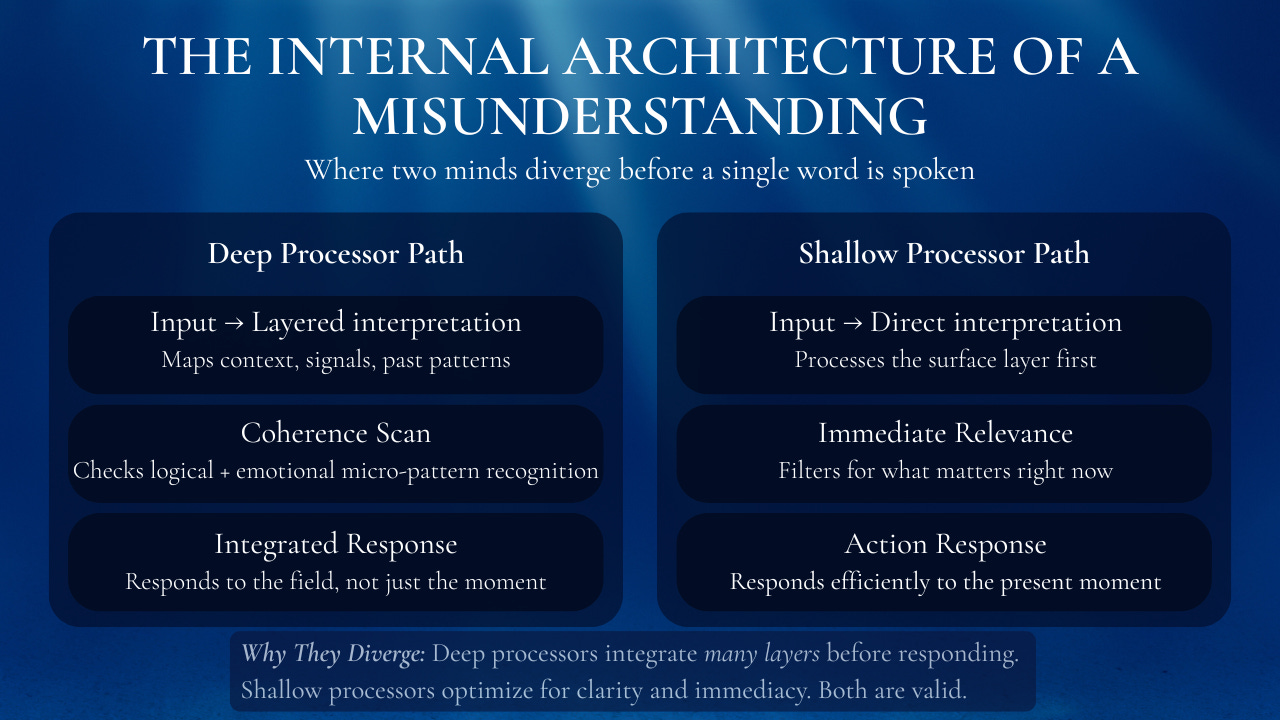
Deep Processor Path
Layered interpretation
Coherence scan
Emotional micro-pattern recognition
Long-term implications
Integrated response
Shallow Processor Path
Direct interpretation
Relevance filtering
Actionable meaning
Present-focused response
Deep processors respond to the field.
Shallow processors respond to the moment.
Neither architecture is superior.
They simply sort reality differently.
This is why two people can talk for an hour and still leave with different understandings:
They never entered the conversation from the same floor of the building.
5. Why Some Interactions Exhaust Deep Processors
Deep processors are not “slow.”
They simply move through many more layers per moment.
This means:
more emotional micro-patterns
more implications
more coherence checks
more internal load
Deep processors accumulate residue.
Shallow processors release it quickly.
This single difference explains:
why deep processors burn out
why shallow processors feel “unbothered”
why tension feels asymmetric
why small interactions can feel heavy
It is not sensitivity.
It is density.
6. Boundary: The Missing Layer That Prevents Collapse
Depth without boundary collapses into exhaustion.
Boundary without depth collapses into disconnection.
Before we map how boundaries interact with depth, here is the structure of the boundary axis:
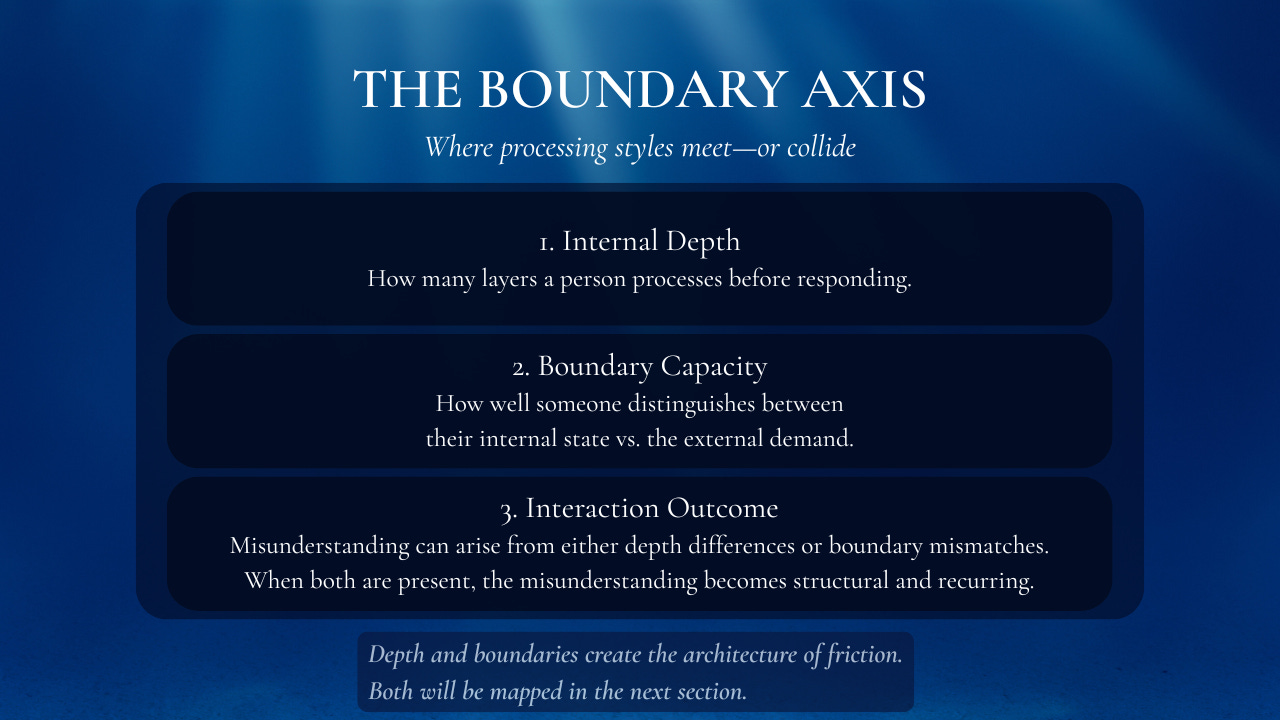
Boundary allows deep processors to:
reduce emotional density
choose which layers to engage
prevent coherence overload
stay clear during asymmetric interactions
Boundary also helps shallow processors:
avoid unintentionally exhausting others
avoid mistaking “speed” for “completeness”
recognize unseen cognitive load in deeper processors
When depth and boundary align, we finally get:
**Clarity without collapse.
Connection without overload.**
Most conflicts aren’t caused by depth —
but by unregulated depth + weak boundaries.
Why Understanding Depth Matters
When we misunderstand depth, we misinterpret intentions.
When we understand it, we unlock repairs that once felt impossible:
relationships
communication systems
multicultural dynamics
leadership
self-understanding
Depth is not a hierarchy.
It is the map of how humans create meaning.
Once we see the map,
we stop blaming people for running a different route.
Next Essay Preview
The next essay explores Boundary × Depth —
why deeper processors suffer more without it,
and how aligned boundaries transform everything
from relationships to resilience.
⭐ Before You Go — If This Helped You, Consider Subscribing
I’m building a long-term series on:
Depth psychology
Internal architecture of meaning
Misunderstanding mechanics
Boundary systems
Resilience for deep processors
Cross-cultural cognition
Your subscription directly supports the continuation of this research series.
👉 Subscribe for future essays, diagrams, and frameworks — free or paid.